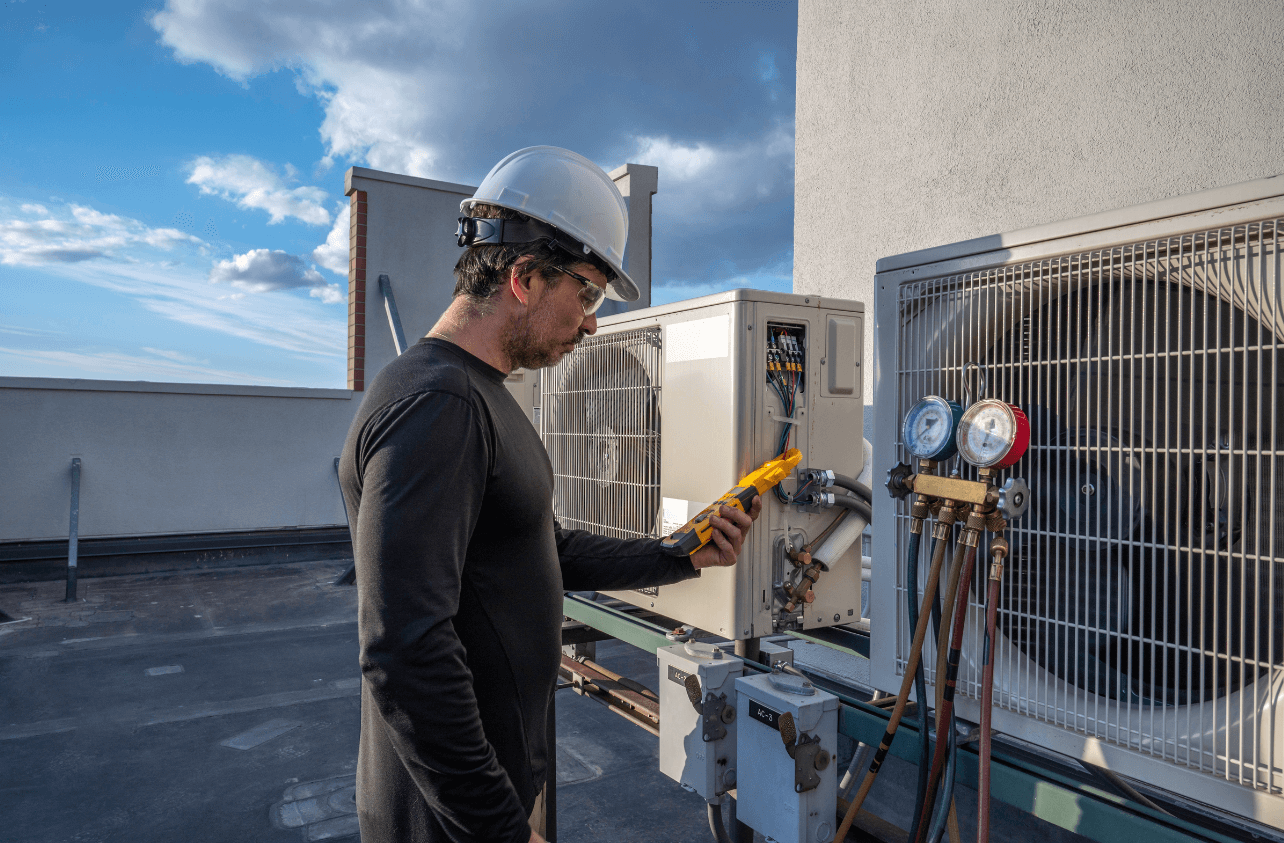
Dubai's commercial buildings operate their HVAC systems under conditions that push equipment harder than almost any other environment on earth. The combination of extreme ambient temperatures, high dust loading, continuous operation, and the unforgiving consequences of failure means that early fault detection is not a luxury — it is a financial necessity. This guide identifies and explains the ten most significant warning signs that a commercial AC system in Dubai is developing a fault requiring professional attention.
The challenge is that HVAC faults are often insidious. By the time a fault becomes obvious — a complete system shutdown, a compressor failure, a significant refrigerant leak — the damage has already multiplied the repair cost compared to what early intervention would have required.
Warning Sign 1 — Warm or Inadequately Cooled Air From Supply Vents
What Is Actually Happening
Inadequate cooling output from an operating system has several possible root causes. Refrigerant undercharge is one of the most common — as a system loses refrigerant through gradual leakage, suction pressure falls, evaporating temperature drops below the design point, and the system loses cooling capacity. The compressor continues to run, consuming energy, but the reduced refrigerant mass flow rate means less heat is being absorbed.
Fouled evaporator coils present a physical barrier to heat transfer. A coil surface coated with dust, biological material, or mineral deposits cannot transfer heat as efficiently as a clean coil. High condenser pressure — caused by fouled condenser coils or elevated ambient temperatures — reduces the system's pressure differential and therefore its ability to produce cooling effect. In extreme cases, high head pressure protection trips the system entirely.
Warning Sign 2 — Unusual Noises From Indoor or Outdoor Units
What Each Noise Type Means
- Rattling or vibration — loose mechanical components, a fan blade partially loose, or debris that has entered the unit
- Grinding or harsh metallic sounds — bearing wear in motors or compressors; once audible, replacement is urgent
- Squealing — belt slippage in belt-driven systems, indicating incorrect tension, worn belt surfaces, or misalignment
- Hissing — refrigerant leak under pressure; any hissing from an HVAC unit should be treated as a leak until proven otherwise
- Banging or knocking at startup — liquid slugging (liquid refrigerant reaching the compressor) or worn valve plates in reciprocating compressors
Mechanical noises are the system's way of announcing a developing problem. Noise that is investigated and resolved early — a bearing replaced before it fails catastrophically, a belt adjusted before it breaks, a refrigerant leak found before the system loses charge — costs a fraction of the consequences if the underlying issue is allowed to progress.
Warning Sign 3 — Unexplained Increases in Energy Consumption
An HVAC system consuming more energy than expected while delivering the same or less cooling is, by definition, operating at lower efficiency. Fouled heat exchangers force the compressor to work harder to overcome increased thermal resistance. A condenser coil or tube bundle that cannot efficiently reject heat causes condensing pressure to rise, which directly increases the compression ratio the compressor must achieve.
Compressor degradation — worn valve plates in reciprocating compressors, increased clearance volumes, degraded scroll geometry — reduces volumetric efficiency. The compressor consumes the same electrical power but moves less refrigerant, reducing system capacity and efficiency simultaneously. In Dubai's commercial context, where cooling loads are large and DEWA commercial tariff rates are significant, efficiency degradation of even 15% represents meaningful monthly costs.
Warning Sign 4 — Water Leakage From Indoor Units or Ceiling Areas
Indoor HVAC units generate significant condensate during normal operation. This condensate must be collected in a drain pan and removed through a drain line. When this system fails, water overflows. Blocked drain lines are the most common cause — dust, biological growth (algae, slime), mineral deposits, and construction debris can partially or completely block the drain.
In a commercial fit-out, water damage to ceilings, lighting, and IT infrastructure can involve costly repair and insurance claims. Beyond property damage, standing water in drain pans creates conditions for biological growth — mould, bacteria, and in extreme cases Legionella-class pathogens — that have health implications for building occupants.
Warning Sign 5 — Ice Formation on Evaporator Coils or Suction Lines
Ice formation on the evaporator coil indicates that the coil surface temperature has fallen below 0°C, which should not occur in normal operation. Evaporator coil temperatures fall below freezing when the suction pressure drops below the normal operating range — caused by reduced airflow across the coil (blocked filters, failed fan motor), refrigerant undercharge, or expansion valve malfunction.
Ice formation is a self-reinforcing problem: as ice builds up on the coil surface, it progressively insulates the coil from the airstream, further reducing heat transfer, further dropping evaporating temperature, and producing more ice. The system runs at maximum electrical consumption delivering zero useful output.
Warning Sign 6 — Frequent Tripping on Safety Controls
Commercial HVAC systems are equipped with multiple safety controls that shut the system down when operating parameters exceed safe limits. When they trip repeatedly, it is because the system is repeatedly reaching a condition that the safety is designed to prevent. Repeated high-pressure trips indicate a persistent condenser-side problem. Repeated low-pressure trips indicate a persistent suction-side problem. Repeated motor overload trips indicate electrical problems.
The critical error is treating the symptom rather than the cause. More dangerously, some building maintenance personnel disable or bypass safety controls to prevent nuisance trips — a practice that removes the equipment's last line of protection against catastrophic failure. Safety controls are a final protection mechanism, not a normal operational feature.
Warning Sign 7 — Poor or Uneven Airflow From Supply Vents
Reduced or uneven airflow in a ductwork distribution system indicates either a generation problem (reduced air volume from the air handling unit) or a distribution problem. Fan motor failure or degraded performance reduces the total air volume delivered to the supply duct network. Failed or closed actuators on variable air volume (VAV) boxes can cause individual zone supply failure while the rest of the system continues to operate normally.
Warning Sign 8 — Declining Indoor Air Quality, Odours, or Humidity Issues
Musty odours from the ventilation system typically indicate biological growth on the evaporator coil, in the drain pan, or in the ductwork. In Dubai's climate, where the condensate environment within an HVAC unit is continuously warm and moist, biological fouling is an ever-present risk for systems not maintained with appropriate antimicrobial treatment.
Chemical odours may indicate electrical burning — the distinctive smell of overheating electrical insulation or a degraded motor winding. This should be treated as urgent. Elevated humidity despite system operation suggests that the dehumidification function is impaired, typically from reduced coil cooling effect or increased outdoor air infiltration exceeding the system's capacity.
Warning Sign 9 — Visible Refrigerant Oil Stains Near Equipment
Refrigerant circuit oil stains are almost always an indicator of refrigerant leakage. HVAC refrigerant contains lubricating oil that circulates with the refrigerant through the system. When refrigerant escapes through a leak, it carries small quantities of this oil. The refrigerant itself evaporates rapidly, but the oil remains as a visible deposit at the leak point — at pipe joints, flare connections, brazed joints, or unit casings.
In UAE regulatory terms, refrigerant leakage must be managed and documented under environmental regulations. A system losing refrigerant will eventually lose enough charge to trigger low-pressure safety trips and ultimately compressor overheating.
Warning Sign 10 — Compressor Short Cycling
Normal compressor operation involves run cycles of 10 to 20 minutes or longer. Short cycling — runs of less than 5 minutes — indicates a system shutting down due to a transient condition and restarting when temporarily resolved. Common causes include refrigerant overcharge causing high-pressure trips, refrigerant undercharge causing low-pressure trips, or a thermostat mounted in a location subject to direct supply air.
Short cycling is particularly damaging because electric motor starts — when the motor draws locked-rotor current before accelerating to running speed — are the highest-stress event in a compressor's operating life. A compressor that starts and stops dozens of times per day accumulates motor winding stress and mechanical wear at a far higher rate than one running in normal sustained cycles.
What to Do When You Identify Warning Signs
Recognising a warning sign is valuable only if it leads to appropriate action. Do not attempt to diagnose refrigerant-side or electrical faults without appropriate qualifications and equipment. Do not reset safety controls repeatedly without identifying the cause of the trip. The appropriate response is systematic professional diagnosis — fault log review, pressure and temperature measurements, electrical testing, and visual inspection — followed by root-cause-based repair.
RSK Technical provides commercial AC repair services across Dubai and UAE, with qualified engineers capable of full system diagnostics on all commercial HVAC types. Early fault investigation consistently results in significantly lower repair costs and less business disruption than waiting for a complete system failure. Contact RSK Technical at +971506956714 for a professional fault assessment.
Need Expert Commercial HVAC Help?
RSK Technical provides commercial HVAC repair, maintenance, and installation across Dubai and UAE — 24/7, certified engineers, transparent pricing.