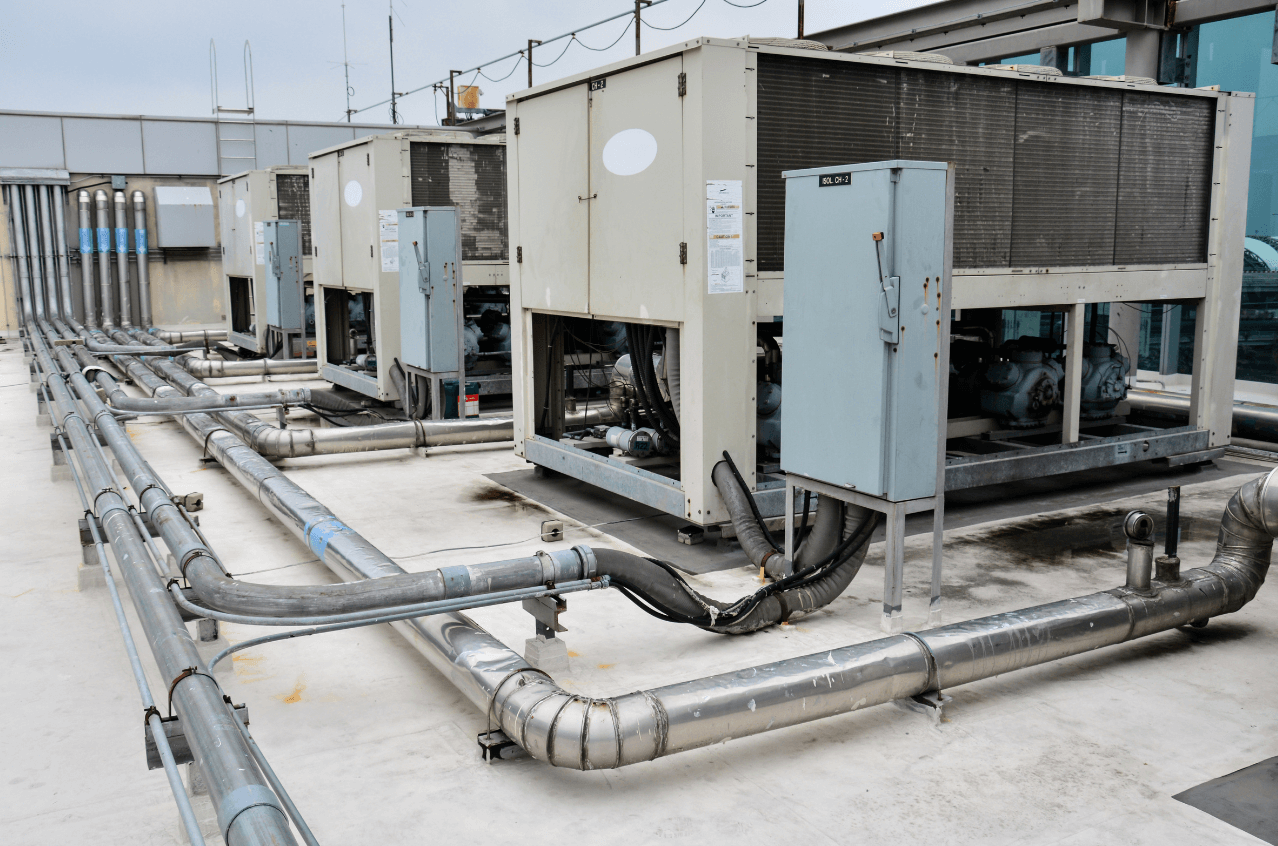
When a new building is being designed, or an existing one is being refitted or upgraded, the choice of HVAC system type is one of the most consequential technical and financial decisions in the process. The system selected will determine capital cost, energy consumption for the next 15 to 25 years, maintenance requirements, flexibility for future reconfiguration, and the extent to which the building can meet UAE energy efficiency regulations. This guide provides a thorough technical overview of every major commercial HVAC system type used in Dubai's buildings.
Central Chilled Water Systems
How They Work
Central chilled water systems use one or more large chillers to produce chilled water — typically at 6°C to 7°C supply temperature — which is then circulated through an insulated pipework distribution network to air handling units (AHUs) and fan coil units (FCUs) throughout the building. At each terminal unit, the chilled water flows through a coil over which building air is drawn, cooling the air before it is distributed to occupied spaces. The chilled water returns, typically at 12°C to 13°C, back to the chiller to be re-cooled.
Where Chilled Water Systems Are Used
Chilled water systems are the technology of choice for large commercial buildings in Dubai. Hotels over approximately 100 rooms, office towers with floor areas above 5,000 square metres, large shopping centres, hospitals, airports, and district cooling systems all typically use central chilled water plant. Modern centrifugal chillers at full load can achieve Coefficients of Performance (COP) above 6.0 — meaning 6kW of cooling output for every 1kW of electrical input.
Technical Performance and Maintenance Complexity
Modern centrifugal chillers achieve IPLV values of 0.40 to 0.50 kW/ton, compared to older technology at 0.70 to 0.90 kW/ton. Variable primary flow (VPF) pumping strategies — varying chilled water flow directly in response to building demand using variable speed pumps — have become standard practice and offer significant pump energy savings over constant flow systems.
Central chilled water systems have the highest maintenance complexity of any commercial HVAC system type. Annual maintenance must cover: chiller mechanical and electrical components; cooling tower systems including water treatment; chilled water and condenser water pumping systems; expansion vessels; BMS integration; and the AHU and FCU terminal unit population throughout the building.
Variable Refrigerant Flow (VRF/VRV) Systems
How VRF Systems Work
Variable Refrigerant Flow systems use a large outdoor unit containing one or more compressors connected to a network of indoor units via refrigerant pipework. Unlike traditional split systems with fixed refrigerant flow, VRF systems use inverter-driven variable speed compressors and electronic expansion valves to continuously modulate the refrigerant flow rate to match the cooling demand at each indoor unit independently.
Heat recovery VRF systems add the capability to simultaneously cool some zones while heating others — using the refrigerant circuit to transfer heat from zones requiring cooling to zones requiring heating. In a building with perimeter offices needing heating in winter mornings while interior zones need cooling, heat recovery VRF can serve both requirements using less total energy than separate cooling and heating systems.
Performance Considerations in Dubai's Climate
An important technical consideration for VRF systems in Dubai is performance degradation at high ambient temperatures. Most VRF system specifications are stated at 35°C ambient. At 45°C to 48°C, which is encountered regularly in Dubai's peak summer, the compressor discharge pressure rises substantially, reducing capacity and efficiency. Specifying VRF systems for Dubai applications requires careful review of manufacturer performance data at elevated ambient conditions — not just the standard 35°C test point.
The large total refrigerant charge in a VRF system serving a multi-storey building is a relevant consideration. UAE regulations require safety measures for refrigerant leak detection and management in occupied spaces when the refrigerant charge per zone exceeds safety limits. Proper system design must address these requirements.
Rooftop Packaged Units
How They Work and Where They Are Used
Rooftop packaged units (RPUs) contain all HVAC components — compressor, condenser coil and fan, evaporator coil, supply and return air fans — in a single self-contained enclosure mounted on the building roof. Conditioned air is distributed to occupied spaces through ductwork penetrating the roof. Rooftop units are particularly well-suited to single-storey or low-rise commercial buildings: retail units, light industrial buildings, warehouses, restaurants, and car dealerships.
Dubai-Specific Maintenance Challenges
The critical performance consideration for Dubai rooftop units is the extreme thermal environment. Rooftop surface temperatures can reach 70°C to 80°C in peak summer conditions, and the air entering the condenser section is significantly hotter than shade-level ambient temperatures due to radiant heat from the roof surface. UV degradation of insulation and sealants, sand accumulation in the unit casing, and physical damage from debris during shamal wind events are all more severe than for indoor equipment.
Commercial Split and Multi-Split Systems
Commercial split systems follow the same operating principle as residential splits but are designed for larger capacity, longer operational hours, and typically higher ambient temperature operating ranges. They are appropriate for smaller commercial spaces — individual retail units, small offices, restaurant dining areas, and hotel rooms in properties too small for central plant. Commercial split systems are available with cooling capacities from approximately 1.5 tonnes (5kW) to 10 tonnes (35kW) per outdoor unit.
Variable Air Volume (VAV) Systems
Operating Principles
Variable Air Volume systems use a central air handling unit that conditions a large volume of air and distributes it through ductwork to individual zones. In each zone, a VAV terminal box controls the volume of air admitted — varying from minimum to maximum flow — in response to the zone thermostat. The central AHU adjusts its supply fan speed to match the aggregate demand of all VAV boxes using a Variable Frequency Drive on the supply fan motor.
VAV systems offer excellent flexibility for buildings with variable and diverse occupancy patterns — different zones calling for different amounts of cooling at different times. The central AHU can incorporate high-efficiency filtration, heat recovery from exhaust air, and precisely controlled fresh air delivery — capabilities that are valuable in larger commercial buildings where indoor air quality and energy recovery are priorities.
District Cooling Systems in Dubai
How District Cooling Works
District cooling is a model in which cooling is supplied to buildings from a centralised cooling plant operated by a utility or district cooling service provider. Chilled water is produced at large, highly efficient central plants and distributed through insulated underground pipework networks to multiple buildings. Dubai is home to one of the world's largest district cooling networks, operated primarily by Empower across major development zones including Business Bay, Downtown Dubai, Dubai Healthcare City, and the Palm Jumeirah.
Technical Implications for Building HVAC Design
Buildings served by district cooling have different internal HVAC design requirements. The interface between the district supply and the building is the energy transfer station — typically a plate heat exchanger that maintains hydraulic separation between the district circuit and the building circuit. Buildings that operate with poor delta-T performance are penalised in district cooling tariff structures. Optimising building-side HVAC operation to maximise delta-T is an important maintenance objective for district-cooled buildings.
Hybrid and Emerging Technologies in Dubai
Thermal energy storage (TES) systems — ice storage or chilled water storage tanks — allow cooling energy to be produced during off-peak electrical hours and stored for use during peak demand periods. In a tariff structure with significant demand charges, TES can offer meaningful cost reduction by shifting electrical load from expensive peak periods to less expensive off-peak periods. For existing Dubai commercial buildings, rooftop PV installations offsetting HVAC electricity consumption represent the most practically accessible form of solar integration currently available.
Selecting the Right System for a Dubai Commercial Application
- Cooling load magnitude and profile — total peak load determines capacity; load profile determines which system type delivers the best annual energy performance
- Building geometry and structure — floor plate size, ceiling height, structural provisions for plant rooms, and roof loading capacity
- Operational requirements — 24/7 operation, simultaneous heating and cooling needs, fresh air ventilation rates, and process cooling requirements
- Maintenance capability — available in-house expertise and feasibility of specialist maintenance contracts for complex systems
- Regulatory and sustainability requirements — UAE energy efficiency regulations, Green Building requirements, and refrigerant handling regulations
RSK Technical provides specialist advice on commercial HVAC system selection, design review, installation, and commissioning for all system types in this guide. Contact RSK Technical at +971506956714 to discuss system selection or any aspect of commercial HVAC for your property.
Need Expert Commercial HVAC Help?
RSK Technical provides commercial HVAC repair, maintenance, and installation across Dubai and UAE — 24/7, certified engineers, transparent pricing.