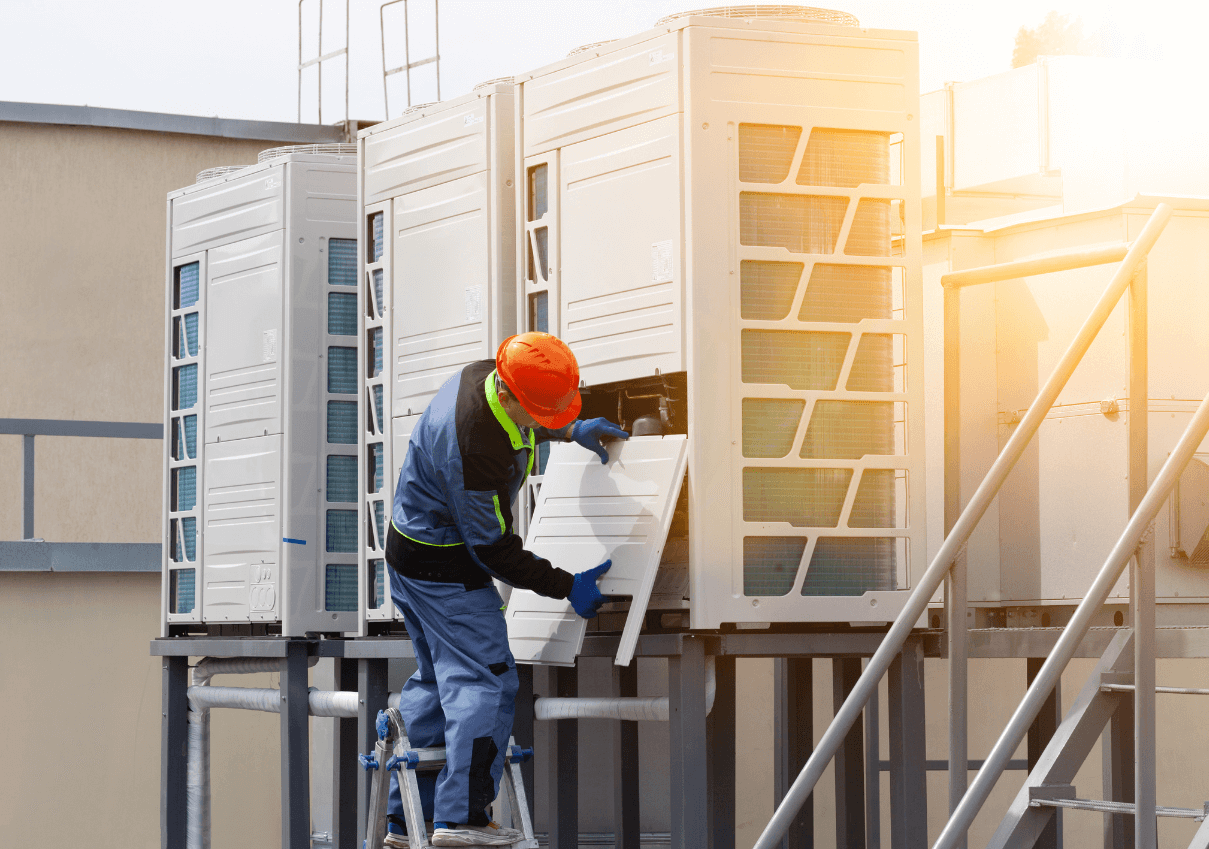
In Dubai, commercial HVAC systems do not get a break. From the relentless heat of June through to the still-warm winters, commercial air conditioning infrastructure operates under conditions that would challenge systems built for far milder climates. The combination of extreme ambient temperatures, high humidity levels in certain seasons, pervasive sand and dust infiltration, and continuous operating demands means that commercial HVAC equipment in this city ages faster, wears harder, and requires more disciplined maintenance than almost anywhere else on earth.
Why Commercial HVAC Maintenance Is Different in Dubai
The Temperature Load
Dubai's summer ambient temperatures regularly reach 45°C to 48°C, with occasional peaks beyond that in exposed outdoor locations. Air-cooled condensers — the most common configuration in commercial HVAC systems — must reject heat into air that is already extremely hot. At 45°C ambient, a condenser is working against a thermal gradient that is roughly double what a similar system would face in a temperate European climate. This translates directly into higher compressor discharge pressures, elevated compressor temperatures, greater electrical consumption, and faster mechanical wear on all moving components.
For every degree of ambient temperature above the system's design point, efficiency drops and component stress increases. Systems that are not regularly serviced — with clean coils, correct refrigerant charge, and properly functioning fans — will run at significantly elevated head pressures that can reduce compressor lifespan by years.
Sand, Dust and Particulate Contamination
Dubai's geographic location means that airborne particulates are a year-round concern, with significant dust events during shamal wind conditions. This particulate matter infiltrates condensers, evaporators, filters, and ductwork continuously. A condenser coil that is 20% blocked with dust and debris will operate at measurably higher head pressure and lower heat transfer efficiency. In most international HVAC maintenance contexts, filter replacement might be scheduled quarterly. In Dubai's commercial environment, monthly inspection and replacement intervals are often technically justified for high-traffic or outdoor-adjacent installations.
Humidity and Condensate Management
Coastal areas and certain seasonal periods bring humidity that creates condensate management challenges. Condensate drain lines in commercial HVAC systems must be kept clear and flowing. Blocked drain lines lead to water backup, evaporator coil flooding, reduced airflow, biological growth in drain pans, and — in ceiling-mounted units — water damage to building structures and fit-out elements. In commercial properties where a water event could damage IT infrastructure, retail stock, or hospitality interiors, this is a very real financial risk.
Continuous Operation Demands
Unlike residential systems that cycle through daily shutdowns, many commercial HVAC installations operate for 16 to 24 hours daily. Hotel systems run around the clock. Retail properties operate through extended trading hours. Industrial facilities may have 24/7 process cooling requirements. This continuous operation compresses the wear timeline for compressors, fan motors, bearings, and refrigerant circuit components significantly compared to the duty cycles assumed in standard equipment lifetime estimates.
The Core Components of a Commercial HVAC Maintenance Programme
Refrigerant Circuit Inspection and Management
The refrigerant circuit is the heart of any vapour compression cooling system. Maintenance of this circuit involves refrigerant charge verification using pressure-temperature analysis appropriate to the refrigerant type — R-410A, R-32, R-22 in legacy systems, or R-134a in chiller applications. Under-charge conditions reduce system capacity and can lead to compressor overheating. Over-charge conditions elevate head pressure and risk liquid slugging at the compressor.
Leak detection using electronic leak detectors or UV dye inspection is equally critical. In UAE commercial buildings, refrigerant leaks carry both financial and regulatory implications. DEWA and UAE federal environmental standards are progressively tightening around refrigerant handling and reporting obligations. A well-maintained system with documented leak checks provides evidence of compliance.
Electrical System Inspection
Electrical connections must be checked and torqued to specification. Loose connections in high-current circuits generate resistance heat that degrades terminals, contactors, and wiring insulation. Thermal imaging cameras are used by professional maintenance teams to identify hot spots in electrical panels that are invisible to visual inspection alone.
Capacitor testing — both run and start capacitors for compressors and fan motors — is a critical maintenance item. Capacitors degrade gradually with age and heat exposure, and a failing capacitor will cause motor starting problems, reduced motor efficiency, and ultimately motor failure. In Dubai's heat environment, capacitor lifespans are noticeably shorter than manufacturer estimates based on temperate climate testing.
Air Side Components — Coil Cleaning and Airflow Management
Evaporator coil cleaning removes biological fouling, accumulated dust, and mineral deposits from condensate that form on the coil fin surfaces. Even a light coating of fouling — invisible to casual inspection — significantly reduces the coil's heat transfer coefficient. A 1mm fouling layer on an evaporator coil has been measured to reduce heat transfer efficiency by 10% to 20% depending on the fouling type.
Condenser coil cleaning for air-cooled systems is arguably the highest-priority maintenance item in Dubai's environment. A fouled condenser in 45°C ambient air will run at head pressures that can push a scroll or reciprocating compressor well beyond its recommended operating envelope. Regular power washing or chemical cleaning of condenser coils is essential for maintaining design operating pressures and energy efficiency.
Filter replacement schedules should be adjusted based on actual contamination rates rather than generic calendar intervals. In environments with high particulate loading — industrial areas near Al Quoz, for example — filter loading rates may justify monthly inspection and potentially biweekly replacement during peak dust seasons.
Recommended Maintenance Schedules for Dubai Commercial HVAC
Monthly Maintenance Tasks
- Air filters — inspect and replace as required based on differential pressure measurement or visual assessment
- Drain pan inspection — verify drain lines are clear and flowing; apply biocide treatment
- Condensate drain flush — flush drain lines with water or mild cleaning solution
- Visual inspection of all units — check for visible damage, unusual noise, ice formation, or water leakage
- Control setpoint verification — confirm thermostats and control systems are operating at designed setpoints
Quarterly Maintenance Tasks
- Refrigerant charge check — verify operating pressures against ambient conditions and system design data
- Electrical connection torque check — particularly important in systems exposed to vibration
- Capacitor testing — test run and start capacitors for all compressor and fan motor circuits
- Coil inspection and cleaning as required
- Condenser fan blade inspection — check for damage, debris, and blade pitch uniformity
- Belt tension and condition check for applicable systems
Semi-Annual and Annual Tasks
- Full evaporator and condenser coil chemical clean (semi-annual)
- Complete electrical panel inspection including thermal imaging scan (semi-annual)
- Full system performance test against original design specification data (annual)
- Ductwork inspection for leakage, damage, and biological fouling (annual)
- Complete vibration analysis for large compressors (annual)
- Water treatment system inspection and recertification for cooling towers (annual)
Annual Maintenance Contracts (AMC) — What to Look For in Dubai
What a Comprehensive AMC Should Include
A well-structured AMC for commercial HVAC in Dubai should specify, in clear written terms: the exact number of scheduled preventive maintenance visits per year (minimum four, ideally six for high-use systems in Dubai's climate); the specific tasks to be carried out at each visit (itemised, not generic); the response time commitment for call-outs between visits; whether parts and consumables are included or charged separately; and the documentation to be provided after each visit.
The Parts-Included vs Labour-Only Question
A fundamental distinction in AMC structures is whether the contract covers parts as well as labour, or labour only. Labour-only contracts leave the client exposed to the cost of every component replacement. Parts-inclusive contracts typically cost more upfront but provide more predictable total maintenance expenditure. For systems approaching or exceeding 5 years of operation in Dubai's demanding environment, parts-inclusive coverage becomes more financially rational.
Priority Response Commitments
A well-drafted AMC should include a specific, written commitment to response time for emergency call-outs between scheduled visits. For commercial operations where an HVAC failure directly impacts business — a hotel, a restaurant, a data centre — a 24-hour response commitment is insufficient. Two-hour emergency response commitments are available from professional HVAC service companies operating in Dubai, and this standard should be the baseline for any commercial operation with genuine continuity requirements.
The Real Cost of Neglected Maintenance — A Technical and Financial Analysis
Energy Cost Impact
A commercial HVAC system operating with fouled condenser coils, degraded refrigerant charge, and dirty evaporator coils will consume measurably more electrical energy to deliver the same cooling output as a well-maintained equivalent. Conservative engineering estimates place this energy penalty at 10% to 25% for a moderately neglected system, rising to 30% to 40% for a severely neglected one.
In Dubai's commercial context, where cooling systems operate intensively for much of the year, this energy penalty translates directly into significant monthly cost. A building running 500kW of HVAC load at an average 20% efficiency penalty is wasting 100kW continuously — money that could fund multiple years of professional preventive maintenance for the same installation.
Equipment Lifespan Impact
A well-maintained commercial HVAC compressor in a Dubai operating environment should achieve 15 to 20 years of reliable service. A neglected compressor — running at elevated head pressures, with degraded lubrication, and cycling under electrical stress from failing capacitors and contactors — may fail in 5 to 8 years. The capital cost of compressor replacement in a medium-sized commercial chiller can run to tens of thousands of dirhams, often requiring crane hire for rooftop equipment and extended operational downtime.
Business Disruption Cost
The cost of an HVAC system failure during peak business operation is almost always larger than the cost of maintenance that could have prevented it. For a hotel, a complete system failure in August means guest complaints, potential room decommissioning, and negative reviews. For a restaurant, it means lost trading hours and food safety concerns. For an office, it means lost productivity and staff discomfort. These costs are real, even if they are harder to quantify than a service visit invoice.
HVAC Maintenance and UAE Regulatory Compliance
Commercial HVAC maintenance in Dubai is not purely a technical and financial matter — there are regulatory dimensions that building owners and facility managers must be aware of. Dubai Municipality sets requirements for building management and facility maintenance that apply to commercial properties, including obligations around equipment safety and operational documentation.
For larger commercial buildings with cooling towers, Legionella risk management is a specific regulatory concern. The UAE has seen increasing regulatory attention to water safety in building services systems. Facilities with open cooling water circuits are expected to maintain documented water treatment programmes and Legionella risk assessments. DEWA's efficiency requirements and the UAE's Green Building Regulations increasingly require that commercial buildings demonstrate HVAC performance that includes documented maintenance histories.
Choosing the Right Commercial HVAC Maintenance Partner in Dubai
The quality of a commercial HVAC maintenance programme is only as good as the technical competence and reliability of the team delivering it. Key criteria for evaluating a commercial HVAC maintenance partner include: demonstrated technical qualifications and certifications for the engineers who will carry out the work; specific experience with the system types installed at the property; a structured maintenance methodology with documented procedures; transparent pricing with no ambiguity around what is and is not covered; and references from comparable commercial clients in Dubai.
A maintenance partner that provides detailed post-visit reports with findings and recommendations, and communicates proactively about developing issues, is a genuine asset to any commercial operation. RSK Technical provides comprehensive commercial HVAC maintenance across Dubai and UAE, including structured Annual Maintenance Contracts tailored to each client's system inventory and compliance requirements. Contact the team at +971506956714.
Need Expert Commercial HVAC Help?
RSK Technical provides commercial HVAC repair, maintenance, and installation across Dubai and UAE — 24/7, certified engineers, transparent pricing.