In Dubai's competitive market for commercial HVAC services, there is a very wide spectrum of quality, technical capability, and professional standards among the companies offering these services. The consequences of choosing poorly are significant and sometimes costly to reverse — a contractor that diagnoses symptoms rather than root causes will replace parts without resolving the underlying problem. This guide provides a rigorous framework for evaluating commercial HVAC service companies in Dubai, with specific criteria drawn from technical best practice and the realities of the Dubai market.
Why the Dubai HVAC Market Requires Careful Evaluation
Market Fragmentation and Quality Variation
Dubai's commercial maintenance market is populated by hundreds of companies offering HVAC services, ranging from individual traders with a van and a set of gauges to large, well-resourced technical organisations with comprehensive diagnostic capabilities. Unlike some professional service markets where licensing or certification requirements create a meaningful quality floor, the variation in HVAC service quality in Dubai is substantial.
The Price-Quality Trap
The most common mistake in HVAC contractor selection is leading with price. Commercial HVAC service is a technically complex professional service where the quality of the engineer carrying out the work is far more determinative of outcome than the quoted hourly rate. A low-rate contractor whose engineer misdiagnoses a fault and replaces the wrong component is more expensive than a higher-rate contractor whose engineer correctly identifies and resolves the root cause on the first visit.
Essential Technical Qualifications and Certifications
Engineer-Level vs Technician-Level Capability
There is a meaningful distinction between a technician — someone trained to follow maintenance procedures and carry out defined repair tasks — and an engineer — someone who understands the thermodynamic, electrical, and mechanical principles underlying the equipment and can diagnose complex or unusual faults systematically. For fault diagnosis on large commercial chillers, VRF system network problems, or complex BMS-integrated installations, engineer-level capability is required.
Manufacturer Certifications
Leading HVAC manufacturers — Daikin, Carrier, York, Trane, Mitsubishi Electric, and others — operate technical training and certification programmes for service engineers. Factory-trained certification demonstrates that an engineer has completed the manufacturer's approved training, understands the proprietary diagnostic software, and is trained in recommended service procedures. For systems from specific major manufacturers, this certification is a meaningful quality differentiator.
Refrigerant Handling and Electrical Certifications
The handling of refrigerants in UAE commercial buildings is subject to environmental regulations requiring technicians to be qualified in refrigerant recovery, storage, and handling procedures. A contractor who vent-purges refrigerant to the atmosphere rather than recovering it is both environmentally non-compliant and likely cutting other technical corners. Commercial HVAC systems involve 380V three-phase electrical circuits — work on these systems requires qualified electrical competency.
Evaluating Diagnostic Capability
The Equipment Test
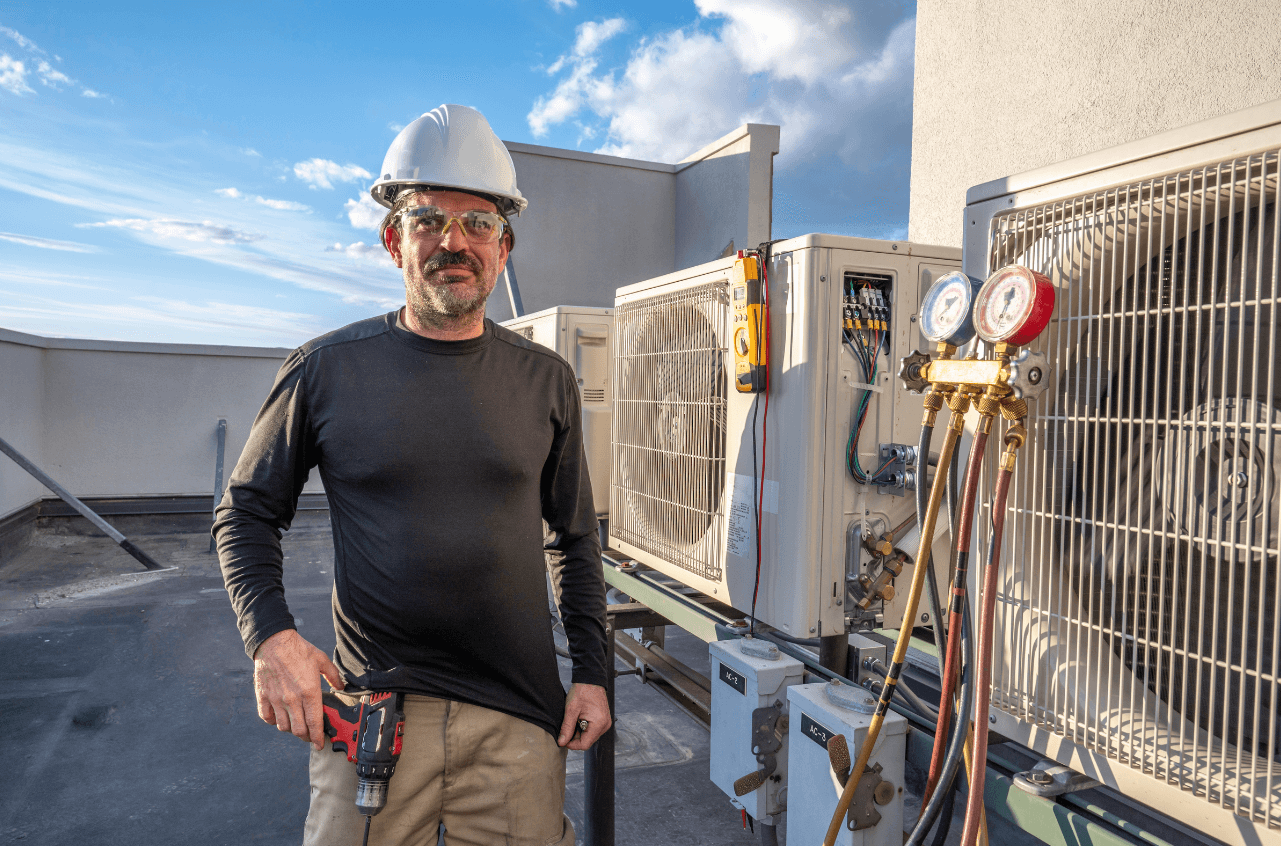
A qualified commercial HVAC contractor should arrive with professional diagnostic equipment. The minimum for competent commercial work includes: a calibrated digital manifold gauge set compatible with current refrigerant types; an accurate clamp ammeter; a digital multimeter with capacitance and resistance measurement; an insulation resistance tester (megohmmeter) for motor winding testing; and a non-contact thermometer. For larger systems, additional equipment should include vibration analysis capability, refrigerant analyser, and manufacturer diagnostic software.
The Diagnostic Process Test
When a fault diagnosis is being carried out, observe the process. A qualified engineer will: systematically review available fault data before opening panels; take measurements before concluding diagnosis; explain findings in terms of what is causing the fault, not just what has faulted; and propose a repair that addresses the root cause. An engineer who makes a rapid presumptive diagnosis without measurement and immediately proceeds to parts replacement is demonstrating poor diagnostic discipline.
The Documentation Test
A professional HVAC contractor provides written documentation of every service visit: findings, measurements taken, actions performed, parts replaced, system condition assessment, and any recommendations for further work. A contractor who provides no documentation, or only a brief handwritten invoice, is not operating to professional standards — regardless of how capable their engineer may be.
Assessing Relevant Experience
System Type and Industry Sector Experience
Not all HVAC experience is equivalent. An engineer who is highly competent on split systems may have no meaningful experience with centrifugal chillers or complex VRF installations. Before engaging a contractor for specific system types, ask directly about their experience. Commercial HVAC serving a hotel has different requirements to HVAC serving a warehouse — hotels require 24/7 availability with discreet maintenance, while industrial facilities require understanding of process heat loads and safety protocols.
Dubai-Specific Experience
Dubai's climate, regulatory environment, and building stock create specific conditions that benefit from local experience. A contractor who has been working in Dubai's commercial market for years understands the performance challenges of Dubai's summer ambient temperatures, the specific contamination patterns of Dubai's dust environment, the regulatory requirements of Dubai Municipality and DEWA, and the common system types in Dubai's building stock.
Evaluating Contractual Terms and Service Level Commitments
Response Time Commitments
A commercial HVAC service contract should contain specific, contractually committed response times. Emergency response — systems completely failed or posing immediate operational risk — should have a response time commitment of 2 to 4 hours maximum in Dubai's commercial market. Vague commitments to "respond as quickly as possible" are not contractual commitments and provide no basis for accountability if response is slow.
Parts Sourcing, Quality, and Warranty
A professional contractor uses original equipment manufacturer (OEM) parts or equivalent-specification alternatives. A capacitor that does not match the original manufacturer specification for capacitance and voltage rating will fail sooner and may damage the motor it is supposed to protect. Professional HVAC contractors stand behind their work with minimum 90-day warranties on parts and labour. A contractor who provides no warranty on repair work is not confident in the quality of their own repairs.
The Annual Maintenance Contract Evaluation Checklist
- Is the scope of maintenance visits specifically itemised rather than described in general terms?
- Is the number of visits per year clearly specified? (minimum four for Dubai; six preferred for critical systems)
- Is the emergency call-out response time specified in contractual terms?
- Are parts covered under the contract, or is labour only included?
- Is there a cap on call-outs between scheduled maintenance visits, or are they unlimited?
- What documentation will be provided after each visit?
- What is the escalation process if faults are beyond the scope of the maintenance contract?
- Is there a formal process for pre-expiry system condition review and contract renewal negotiation?
Red Flags That Indicate a Poor-Quality Contractor
- Engineers arrive without appropriate diagnostic equipment — relying on experience and guesswork rather than measurement
- Rapid presumptive diagnosis without systematic investigation — parts quoted before measurements are taken
- Inability to explain fault causes in engineering terms beyond "it was old" or "it just stopped working"
- No post-visit documentation provided
- Reluctance to disclose the specific qualifications of assigned engineers
- Vague or heavily qualified warranties on completed repair work
- Pressure to replace components that have not been definitively identified as faulty
- Refrigerant vent-purging rather than recovery when carrying out repairs
The Onboarding Process — What to Expect
A professional HVAC contractor beginning a new maintenance relationship should carry out a thorough baseline assessment of all systems before the first scheduled maintenance visit. This assessment establishes the current condition of each unit, identifies pre-existing faults, documents as-found operating parameters, and creates a system inventory. Be cautious of contractors who are eager to begin maintenance without first understanding what they are maintaining.
Using Technology to Enhance Contractor Accountability
Modern BMS and commercial HVAC equipment increasingly support remote monitoring — the ability for a service contractor to review system operating parameters, fault histories, and energy consumption data remotely via secure connection. Remote monitoring allows a contractor to detect developing faults between scheduled visits — sometimes days before they cause a system trip — and to respond proactively rather than reactively.
RSK Technical works with commercial and industrial clients across Dubai on structured AMC relationships with consistent engineering team assignment, detailed digital system records, proactive condition reporting, and genuine accountability for outcomes. To discuss your commercial HVAC requirements, call RSK Technical at +971506956714.
Need Expert Commercial HVAC Help?
RSK Technical provides commercial HVAC repair, maintenance, and installation across Dubai and UAE — 24/7, certified engineers, transparent pricing.